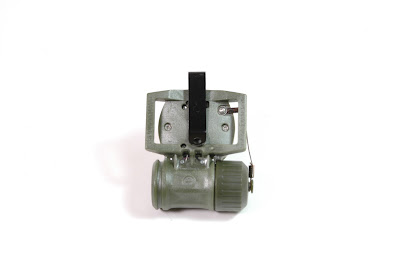
Friday, July 29, 2011

Whew...

It's been a while. It has been pretty busy here at Austere Provisions Company as we work on expanding our product line up from trusted manufacturers as well as work on developing a number of new projects.

Keep an eye out here and on our Facebook page for news. The first item is a morale and mindset patch.
From Product Releases


A reminder to yourself and team mates that walking the warrior path is a thinking mans game and the ultimate weapon in dominating your environment is the brain.

This patch stemmed from a group of colleagues I am working with to bring some great new concepts to production to make it easier. Look for more details on this group at a later time.

One of the products that we are in final production with is a 2-1 sling device. I have had this idea on the drawing board since late 2007 - early 2008 time frame. At the time I was working in Iraq doing static security and I spent quite a bit of time in and out of vehicles, checking OP/LPs, walking posts or spending time at ECPs and the like. I preferred a single point sling for the ease of getting the gun on target but a two point was much more comfortable for 'walking the beat' and the combination of an adjustable sling (BFG VCAS or VTAC padded sling) and 'wrapping the gun up' made life easier when going hands on for searches or climbing ladders, etc. Not being satisfied with a one or the other solution I started brainstorming solutions. I came up with a couple of solutions and side lined the project while first getting APC stood up.

Fast forward to December 2010, I discussed this project with Clint Lynch of Sentinel Design and we started working on executing the concept. Below you can see the pre-production short run for testing.

From Product Releases


While I am a bit partial I will say that I am really stoked with how this turned out and can't wait to get these on the shelf. The first run is planned to be in FDE (Flat Dark Earth) followed by black as an option in later batches. As depicted in the picture the center hole is for slings with QD connections, the outer holes act both to reduce weight and allow HK hooks or mash hooks to be clipped in should you perform those parts or are using weapons that do not support QD connections. Speaking of weight reduction, the sample shown in the picture is functionally the same weight as a ITW fastex pair (male and female) so you shouldn't notice the extra weight on your sling. While there may be some variation in the production units I don't see it being much more than 0.01 ounce.

Once the first batch is done I will be sure to announce them through all of our channels and have a link to the website for purchase.

As development on other projects and expanding APC has taken quite a bit of time the blog has not had much information put out. Look for that to change, not just with product of the week but other topics of interest. So stay tuned and be sure to hit check out Facebook and the APC website.

Stay sharp,

Mike

Sunday, February 13, 2011

PRODUCT RECALL

Austere Provisions was recently notified of the recall of the "Triad Sterile Lubricating Jelly" that we include in our trauma kits and attached to the nasal airways that we sell. Due to the fact that we provide these as give-aways for courses, charity events, and product demos we are trying to get the word out as far as possible. We will replace the lubricant packet at no cost to the customer/recipient of the kit but we need to know if you still have the kit in hand. So, if you have either an IC3, LMS Comprehensive kit, or individual nasal airway that you purchased from Austere Provisions Company please email me at mike@austereprovisions.com for info on how to receive the replacement.

As of 02/13/2011 any kits or airways leaving the shop were stocked with a replacement equivalent component not effected by the recall.

Detailed information about the recall from the manufacturer:

URGENT MEDICAL DEVICE RECALL
This is to inform you of a product recall involving Sterile Lubricating Jelly manufactured by Triad Group.
This recall has been initiated due to concerns expressed by the Food and Drug Administration regarding the
validation of the gamma radiation sterilization cycles for these products. We are initiating this recall because use
of inadequately sterilized product might result in patient infection.
This recall extends to all Lots of Sterile Lubricating Jelly remaining within their labeled expiration dating (three
years), including all Lot numbers beginning with the digits 7, 8, 9, or 0. We began shipping the Lots of product
subject to this recall in January, 2007
Please immediately examine your inventory and quarantine product subject to recall – any stock of Sterile
Lubricating Jelly manufactured by Triad Group. In addition, if you may have further distributed this product, please
identify your customers and notify them at once of this product recall. Your notification to your customers may be
enhanced by including a copy of this recall notification letter.
This recall should be carried out to the user level. Your assistance is appreciated and necessary to prevent
potential patient harm.
Please complete and return the enclosed response form as soon as possible and return the recalled product to
Triad Group.
If you have any questions please call Triad Group Customer Service Monday through Friday, between the hours
of 8:30 A.M. and 4:00 P.M. Central Time: 262-538-2900 ext 2761.
This recall is being made with the knowledge of the Food and Drug Administration.
Yours truly,
Jack Waterman
Jack Waterman
Regulatory Affairs Manager

__________________________________

Thanks for your patience as we work to correct this issue,

Mike Griffin
Owner
Austere Provisions Company

Sunday, October 24, 2010

Friend or Foe?

How do you tell the difference under low light or no light conditions? How do you prevent a catastrophic incident due to misidentification? Through the use of effective signaling, both passive and active, the chances of incidents like this can be reduced if not prevented.

Passive means include items like IR flags, squares, unit patches, ID patches, etc. Active means include items like this week's product of the week: The Neptune Beacon from CEJAY Engineering. Designed to fill a number of roles in order to reduce the overall load today's warrior has to carry in order to complete the mission at hand.

Information from the manufacturer:

The Neptune beacon is a multi purpose multi function signal light developed to provide the soldier and officer several ID and illumination tools in one compact package. The Neptune light produces a wide, variable-output, flashing or constant on, IR, Blue or White signal. In flashing IR mode, the intense brightness of the Neptune’s signal allows it to be used as either an individual or vehicle Combat ID marker. In Blue or White signal mode, the beacon can be used as either a land or water distress signal.

The Neptune high impact plastic housing and sealed electronics are engineered to withstand harsh environments and chemical exposure. Powered by one CR123A, the Neptune is lightweight, rugged, versatile and submersible to 150 feet making the beacon superbly suited for water to land deployment and special operations applications.

Despite its small size, all Neptune functions can be controlled with one hand even when gloved. The Neptune’s signal is turned ON or OFF simply by rotating the battery cap. The single mode selection button allows the user to select light color and move between flashing or constant on signal mode. Brightness level can also be adjusted in constant on mode, making the light useful as either a signaling device or lamp.

The Neptune can be attached to PALS webbing, belts, or uniform by using the supplied locking spring clip or wrist mounted with the included wrist strap. The light can also be used with optional head/helmet strap for use as a headlamp.

Specifications

Weight: 76 Grams | 2.7 Ounce (with battery)
Size: 49mm x 27mm | 1.9" x 1.06"
Flash Mode: Constant ON with Brightness Control | Fixed Flash
Signal: IR, White, Blue LED
Battery: One CR123A
Coverage: 360 degrees x 180 degrees
Switching: Rotate Battery Cap and Mode Switch
Operating Life: 100 Hours in Flashing signal mode | 8 Hours at maximum brightness in Constant ON signal mode
Environmental: Waterproof 150 feet
Options: Neptune Signal Light (902900)


Personal experience:

When I met with Steven Bronson of CEJAY in January of this year at SHOT Show and saw the Neptune I was immediately interested. The Neptune offered all the functionality of the current beacon that I was using (IR, White, Blue flash) with the addition of the constant on and the ability to dim. As well, by using the individual LEDs for each light as opposed to a filter this eliminated white light bleed around the filter. The few full size beacons I had in my inventory from Iraq had all been taped up around the joints of the filter to prevent any white light bleed, functionally preventing easy transition from IR to white/blue. Not to mention the reduction in bulk by going to the Neptune.

While all that seemed great I was still somewhat cautious with using a new unit and even more cautious about recommending this new design to customers and colleagues. Shortly after SHOT I got signed up with CEJAY as a dealer and purchased a small number of Neptunes, integrating them into my training gear and putting them out to some colleagues for evaluation in a variety of conditions. After approximately three months of use in a variety of applications primarily attached to the body armor of full time instructors and combat developers I felt comfortable recommending them.

The unit that I retained for my personal use started life off in a container of water and placed in the on position (blue flash mode) and left in water until the battery died somewhere between day five and six, slightly longer than the rated 100 hours. The unit was removed from the water and exterior dried, battery compartment opened and found to be completely dry. Examination revealed no moisture under lens and battery was replaced revealing normal operation. After this test the unit was attached to my primary plate carrier via a short MALICE Clip (see photos below). While I do like the ability to move the Neptune around with the locking clip, the MALICE Clip offers a more permanent mounting option.

The most recent use of this light was at an EAG/Pat Rogers class in Alliance Ohio where we ran through shoot house evolutions in low light conditions. Myself and my partner ran Neptunes on the rear of our vests in order to identify ourselves to each other and the instructors and safety officers while moving through class. While other students used chem lights which were functional for this application the Neptune offered a reusable and multipurpose solution to this requirement as well as many others such as functioning under NVGs.

A few pics:

Wrist band:
From Blog album

Wrist band in use:
From Blog album

Clip:
From Blog album

MALICE Clip:
From Blog album

MALICE Clip in use:
From Blog album


In addition to identification this light is optimally setup as an emergency signaling beacon. As well, for those that may not need the IR function a training model is available with the same specifications except that the IR LED is replaced with a visible red spectrum LED making it even more well suited for backpackers, adventurers, and the like.

Check back in the next few days, I will be adding these to the website and uploading a video explaining the various functions of the Neptune.


That is all for tonight,

Mike

Wednesday, September 15, 2010

Size Matters...

...And bigger isn't always better. Especially when it comes to gear for remote/tactical/austere/etc work. Smaller, more durable, lighter, etc are the characteristics professional adventurers are looking for.

This weeks product of the week lives up to the word compact. The Pocket BVM (manufactured by MicroBVM Systems Ltd.) is an adult Bag Valve Mask that is comparable in size to a couple of combat dressings (H Bandage or OLAES Bandage). Back in the day I would take whatever BVM I could find at a reasonable price and vacuum seal it. This worked OK but had a serious memory effect on the material which left you with about half of the tidal volume that the bag started out with, and often hampered 'bounce back' or reinflation after each respiration. It was an imperfect solution at best but it was what we had 'back in the day'. Now with the medical industry actually interested in providers working outside of the hospital and even the urban street we are starting to see equipment that doesnt take up so much space, and some of it is actually getting lighter.

Some info from the manufacturer:

The Pocket BVM TM is Ideal for various emergency and clinical settings where resuscitation and breathing support to the respiratory distressed or non-breathing patient is required along side the space factor.
The Pocket BVM TM when packaged is a pocket sized fully functional BVM.
The Pocket BVM TM will replace any standard BVM by maintaining all the standard working factors and operation possibilities and will improve the use effectiveness by adding the accessibility, availability and last but not least maximize limited storage space by up to 75%.
The Pocket BVM TM advantages and capabilities
  • Up to 75% cube space reduction, space efficient
  • Textured grip to prevent slippage
  • Single Use eliminates cross contamination
  • Superior resistance to high/low temperature unaffecting bag re-expansion
  • An Endotracheal Tube can be connected to the Resuscitator
  • Deflector, see through mask
  • Peep valve adaptor can be attached
  • Ergonomic cushioned mask design fits securely to facial contours
  • Includes Bag, mask, patient valve, reservoir bag, inlet for oxygen drive line
  • Two independent Inlet Valves, The Resuscitator has two independent inlets, one for air, and the other for oxygen. When the Resuscitator is attached to an oxygen supply, it enables to Oxygen the patient.
  • The Pocket BVM TM is easy to use, without operational fatigue, it requires minimum pressure to be compressed and, due to its design, quickly recovers its shape, so as not to cause operational fatigue, even after extended continuous use.
    The Pocket BVM TM can be folded compactly to fit a small storage case.
  • The Pocket BVM TM Manual Resuscitators has enhanced performance and reliability. All equipment complies with the Safety Standards


While I have had this product for some time and been playing with one I dedicated as a demo I have been pleased with the durability. The case is not super tough but at the same time isnt over engineered thus adding unnecessary weight. Outside of the compactness the function is pretty standard of a BVM. It does not include an O2 hose, the green tubing is simply and O2 connection. In order to run O2 to this BVM you would need a double ended push fit section of O2 tubing. To me, this is a major issue as the times I will be using this I will most likely not be carrying an O2 tank and if I am I can spare an extra ounce for the extension tubing.

The valve to mask interface uses standard airway fittings, allowing you to connect to any standard airway device such as an ET Tube, King Tube, Combi-Tube, Trach, etc as well as any standard mask. Although, I have been very happy so far with the mas that is provided. It is flexible and gives good compliance as best I have been able to assess on manikins and living tissue. I have yet to have the opportunity to try one on a respiratory or cardiac arrest patient for myself. Considering that I have swapped out all my old vacuum sealed BVMs for the Pocket BVM, should the need arise (and hopefully it doesnt) I will be able to offer a report back on the function.

And no review would be complete without a few pics:

From Blog album

Diameter at the widest point (the outer ring of the case) is right at 5.25".

From Blog album

Thickness measures in at 2.5".

From Blog album

In comparison to a large OLAES Bandage.

From Blog album

Each component shown comes packed in the case, Mask-Valve-Bag-Reservoir.

From Blog album

In use with the included mask.

From Blog album

In use with a standard ET Tube.

In conclusion, if you need a compact BVM for your remote med bag check out the Pocket BVM from Micro BVM.

Where to get them:

Pocket BVM/Micro BVM now available at Austere Provisions Company


Before I sign off...

It has been a few weeks since a post, hopefully that will not be a trend. In the months leading up to SHOT everyone, including myself are working to get projects done in time for release early next year. I am looking to get out in the field and get some testing done on some survival gear and have an extensive list of tactical training planned for this fall and next year. So look for some great reviews as well as some AARs which I will be posting so customers, friends, and colleagues can keep up with our activities.


Anyway, that is all for tonight, stay sharp,

Mike

Sunday, August 22, 2010

When you need a Trauma Kit....

You need it NOW.

This weeks Product of the Week is the Blue Force Gear Trauma Kit Now. Since it's release this design has interested me for a number of reasons. The pouch is based on two piece concept which we initially saw in tear off and cable release pouches. Downsides to these are that they are higher profile due to the multiple layers of material required to support the hook/loop attachment system. Some of these pouches are very good, and I have used a number of these but the thickness and protrusion from your armor has to be accounted for when setting your gear up. The Trauma Kit Now (TKN) functions on an insert and pouch concept where the removable portion that carries your med gear simply slides into a fitted pouch. This reduces overall bulk as well as ease of access as it takes minimal strength (as you may see in an injured arm) to slide the insert out vs. overcoming a large panel of hook/loop.

Another feature I particularly like about the TKN is the insert design. As opposed to simply making it a pull out pouch it is setup almost like a nylon surgical tray allowing me to lay it on or next to a patient and work from the 'tray' as opposed to setting off the med kit grenade that is seen in some kits where you have to pull 'this' out in order to get to 'that'. Everything is exposed and easily accessed once the tray or insert is pulled out.

So let's hear the manufacturers details:

Blue Force Gear redefines the commonplace first aid kit with the fastest one-handed trauma kit ever - the Trauma Kit NOW!™ Reach for the tab of Trauma Kit NOW! ™ and receive instant access to life-saving supplies even with an injured hand. Tapered carrier design allows the insert to clear the pouch regardless of how full the kit may be. Top of pouch has MOLLE webbing for attaching a Benchmade™ Rescue hook, Trauma Shears, or one of our Tourniquet NOW Strap™ tourniquet holders (available separately). Pouch flap has a Velcro loop field for medical ID patches.
Supplies not included.

Life Time Warranty!
MADE IN THE USA


Here is a few pics of one I have setup on a chest rig:

From Blog album

The MOLLE footprint for this pouch is 3 columns by 3 rows. Actual footprint, seam to seam, is 4.5w x 6.5h.

From Blog album

Pouch footprint.

From Blog album

Insert removed. (shown with TMS MED patch and TQN Strap, not included). Insert velcroes closed to allow it to be removed from a vest or belt and tossed in a pack or tossed to an injured team mate without loss of supplies.

From Blog album

Once the insert is opened all equipment is easily accessible, to the point that multiple providers could work from a single insert on the same patient.

From Blog album

Insert show empty.


In conclusion, I really like this pouch for both self-aid/buddy-aid setups as well as setup for medic-aid either carrying one or multiples on the medic's second line or as rapid treatment kits on the exterior of a med pack. As well, this pouch easily holds both the APC Comprehensive Trauma Kit built for LMS Defense and the APC IC3 Med Kit.

Where to get it:

Blue Force Gear Trauma Kit Now available at Austere Provisions


Until next time, stay sharp,

Mike

Tuesday, August 10, 2010

As you may have seen mention in last weeks post I spent a good bit of time in June and July training. One of the courses that I attended was the LMS Defense No Light Operations course in Alliance, OH. While there I had the opportunity to check out some new and not so new gear from industry developers including Stephen Hilliard and Pat Rogers. Stephen works for Blue Force Gear and while talking between evolutions I had a chance to discuss with him the Ten Speed series of pouches. These have been out for a few years and the line has been growing to meet a wider array of end user's needs. While the idea of a multipurpose, low profile, and light weight pouch intrigued me I had obvious concerns about the durability of such a product.

So let's take a look at these things, from the manufacturer's website:

Our Ten-Speed Mag Pouch™ works from the premise that a magazine pouch should have excellent, consistent retention without a lot of securing straps, lids, or flaps to get in the way of a smooth, consistent reload. When not in use, the pouch is designed to lay flat against your vest or carrier so that it is completely discrete and unobtrusive. Primarily intended for personnel performing fast, short duration operations where speed and a low profile are paramount. Due to the use of high performance materials, the Ten Speed Pouch is also extremely lightweight registering barely three ounces on the scale. Not limited to magazines, it will also securely hold some types of Flash Bangs, Strobes, Lights, etc. Attaching to any MOLLE/PALS surface, its use is only limited by your imagination. The Blue Force Gear Ten Speed Pouch™ is made out of military-grade heavy duty elastic and Cordura fabric/webbing right here in Georgia.


During class a number of students used the Ten Speed M4 pouch to hold M4 mags but also to hold other items such as trauma kit contents, radios, flashlights, and flash bangs. While some may be thinking, "yeah, and..., I can do that with a standard triple M4 pouch". My response to that is, when you dont need to carry anything in that triple M4 pouch you now have a bulky pile of cordura sitting there that will easily get caught on any obstruction it can find when moving through a structure or in brush, not to mention the weight whereas the Ten Speed pouches are elastic based they tighten up and lay flat when not in use reducing the overall profile of your gear and they are quite trim on the weight side (weights of Ten Speed M4 Pouches: Single-1.4oz, Double-2.7oz, Triple-3.2oz).

As someone who appreciates modularity in a pouch (or most anything) the Ten Speed Series gets my vote since it offers a relatively secure package that can handle small or large items without having to spend your evening weaving MOLLE/PALS to prep for a class or a mission that has different requirements from normal gear setup. As well, for me a big benefit of this series is the ability to stash a Ten Speed Triple M4 on the back of my vest and have the ability to run my rig in more of a traditional shooters platform sans med pack and should I need to transition back to a med pack or ruck I can simply remove the contents whether they be mags, smoke, or bangs and there is no unnecessary bulk under my pack that would increase profile. To me it is a win-win.

While all of these things were positives and points I had already evaluated I had not had the opportunity to thoroughly evaluate extended use of the pouches. Having a chance to talk to Pat and look over his gear which included Ten Speed Pouches I was pleasantly surprised to see that while well worn the materials and craftsmanship had held up and continued to have quite a bit of life left in them, even after years of regular use (by my accounting Pat averages 4-6 blocks of instruction a month which equals a good bit of time in gear). This shouldnt be a surprise though as just with all Blue Force Gear the Ten Speed series is all Made In The USA with domestic components and while the price may be slightly higher than some of the options available at your local discount surplus store you wont be able to find a comparable design or execution from any of the knock off brands.

So after all that, I decided to pick a few of these up and stick them on some gear to get a feel for how best to integrate them. The one shown below is a triple that I have placed on my primary med bag. This bag is setup as an assaulter's med bag, the intent is to have a relatively low profile with the primary capability of treating and stabilizing life threatening injuries in a warm zone environment prior to moving to a cold zone or CCP where more definitive support equipment can be staged. For that reason the Ten Speed Triple works perfectly to plus up the fire superiority component of care under fire and allow me to carry extra mags, smoke, or bangs that either I can use through removal of the pack or team mates can use by working off my pack and me working off their pack or vest.

From Blog album

Extra Bullets

From Blog album

Or Extra "Band-aids"

So, if you need a lightweight and low-profile/low-bulk solution to carrying your fighting load take a look at the Ten Speed series of pouches.

Where to get them:
Blue Force Gear Ten Speed Triple M4 Mag Pouches at Austere Provisions Company


Look for more offerings of Blue Force Gear products at Austere Provisions Company, BFG is making a solid product with solid designs and putting Americans to work. I personally take pride in carrying such a product and supporting such a company and I believe the customers of Austere Provisions Company feel the same way.

So, until next time, stay sharp and stay safe,

Mike

Honorable Mentions: (Look for these more often)

www.LMSDefense.com
www.EAGTactical.com

Friday, July 30, 2010

We're Back...

After no posts for a few weeks we are back. Since the beginning of July I (Mike) have been on the road taking classes to freshen up on skills as well as get the opportunity to work through some new concepts and network with some industry partners. To start I ran up to Alliance, OH to attend the LMS Defense No Light course and function as med support as well as cover some of the logistical support. This class was great on many levels considering I had the opportunity to get back together with my buds from LMS, meet Pat Rogers of EAG Tactical, train and network with both Stephen Hilliard from Blue Force Gear, and Clint L. from FNH, not to mention the guys from APD who were stellar hosts and tacticians. Formal AARs are available here and here (requires registration, make sure to follow instructions about posting an intro). Note: The hack for carrying chemlights on a grenade ring shown in a previous post proved to not be a solid concept. As I mentioned in the post this was untested, we tested this during class and consistently lost chemlights. I have moved to carrying mine in the elastic loops of an EAG Tactical Dump Pouch, works great.

Once class was over in Ohio I headed home to do a bit of laundry, grade some tests and head off to my part time teaching job at a local Paramedic program. Once laundry was done and I had enjoyed a few days with my family I hopped on a plane to Reno, NV to attend Firearms Instructor Development at the LMS Defense Combat Development Center located just up the road in Fernley, NV. An excellent course with a great group of warriors and the opportunity to play with some hardware while updating our software. AARs available here and here. After finishing up Instructor Dev I stuck around to help teach the Low Light course running Saturday and Sunday. The class was filled with a great group of students. The first evening was made rather "sporting" by a pretty solid dust storm rolling in but everyone endured with an even greater appreciation for full light/full visibility shooting environments. The rest of the evening and the following night presented perfect weather for a solid class. The AAR for Low Light can be found here. So after a couple hours of cleaning and packing gear and a few minutes of shuteye it was time to get back on a plane (or three) and head home in time to grade a few more tests and teach some classes.

On to this weeks Product Of The Week...

For some time now I have been working on finding a way to better streamline my gear as well as set it up in a graduated or scalable manner. Rationale being that I dont always need "everything", meaning not all training or operational missions require a complete belt rig, plate carrier/vest/chest rig, and assault pack/assaulters med ruck/etc and setting up each component so that I have a little bit of the essentials on each line allows me to tailor my gear to the mission. For a good bit of time there was no good solution for carrying med gear on your first line. When in Iraq I usually just tossed a dressing of some sort, a tourniquet, a nasal, and a decompression needle in a cargo pocket and pressed on. It wasnt comfortable, it was bulky, and routinely caught on things when getting in and out of vehicles or crawling into the access hatches of OP/LPs. After not using a battle belt for quite some time I recently went back to using one as the designs have come a long way in the last few years. I opted for the Blue Force Gear SOC-C Modular Padded Belt Kit. I chose this kit for a number of reasons, the company is solid, it is completely American Made, it is well thought out, and gives the user the option of adding armor for added protection.

Once I got my belt setup to carry bullets I started looking at options for carrying "bandaids" (med gear). Initially I dug out an old GPS pouch and stuffed a SWAT-T and Primed gauze in it and used that. After looking at designing a 1st line med pouch I decided to order a couple of Blue Force Gear Boo Boo Pouches to see what they would hold for trauma gear. Turns out they are sized just right for a wrap TQ and some form of packing material, whether it be Primed gauze or QuikClot Combat Gauze.

Here is a few pics:

From Blog album

Pouch only

From Blog album

Pouch with Primed Gauze and SWAT-T

From Blog album

Pouch with Primed Gauze and TK-4 (TK-4L also fits)

From Blog album

Pouch mounted on Blue Force Gear SOC-C belt, this one is mine and is packed with a SWAT-T and QC Combat Gauze.

So why did I do this and what are the benefits: I can ditch my armor and keep my belt rig on either while in a secure area or while running drills where armor is not necessary and may hamper the learning process but I can maintain a minimum of med gear. Just enough to stop a major bleeder until I can either get to my med pack or my vest or until a buddy can get reinforcements to me. As well, distributing gear across your 1st, 2nd, and 3rd lines allows for better distribution and prevents one line of gear from becoming overly cumbersome.

Where to get these pouches:

Blue Force Gear Boo Boo Kit Pouch at Austere Provisions Company


That is all for this week, got a couple of new items in plan to do detailed reviews on some established items in the next few weeks. Looking forward to it. Until next time, stay sharp, stay safe,


Mike